Saturday, April 18, 2015

Kafunta means CRAZY

You could smell it before the safari vehicle arrived and turned off its noisy engine. But even then the gore was hidden. Five female lounging lions blocked the road, panting heavily to help digest their meal. The previous night the pride had taken down a hippo that had strayed from the river under the cover of darkness to munch on the grassland. The car turned off the road, crunching the drying grasses, and inched under the cover of some nearby bushes. My heart skipped a beat as I stared into the eyes of an awake but calm sandy-haired carnivore nestled under a bush eight feet away. Is this safe, I thought? We continued to inch forward, the pungent scent of hippo flesh getting stronger. All that was visible under the bushes was the gigantic rib cage of a hippopotamus. About ten lions, all females or young males, feasted on the remaining meat. One lion had the sizable and still intact foot of the hippo in its mouth. It shook its head violently back and forth, trying to rip through the 2 centimeters of skin.

I was fascinated. I was scared out of my mind.

We had driven ourselves into a trap, with branched and green leaves creating a tunnel around us. There was no physical barrier stopping the lion eight feet away from jumping up onto the door-less back seats of the safari truck. If we needed to make a quick getaway there was no path to refuge. Surprisingly the loud truck didn’t bother the animals in the slightest. When we had enough excitement, our guide took a Y-turn, just noisily backing up into a pride of feasting lions, and we went on our way.
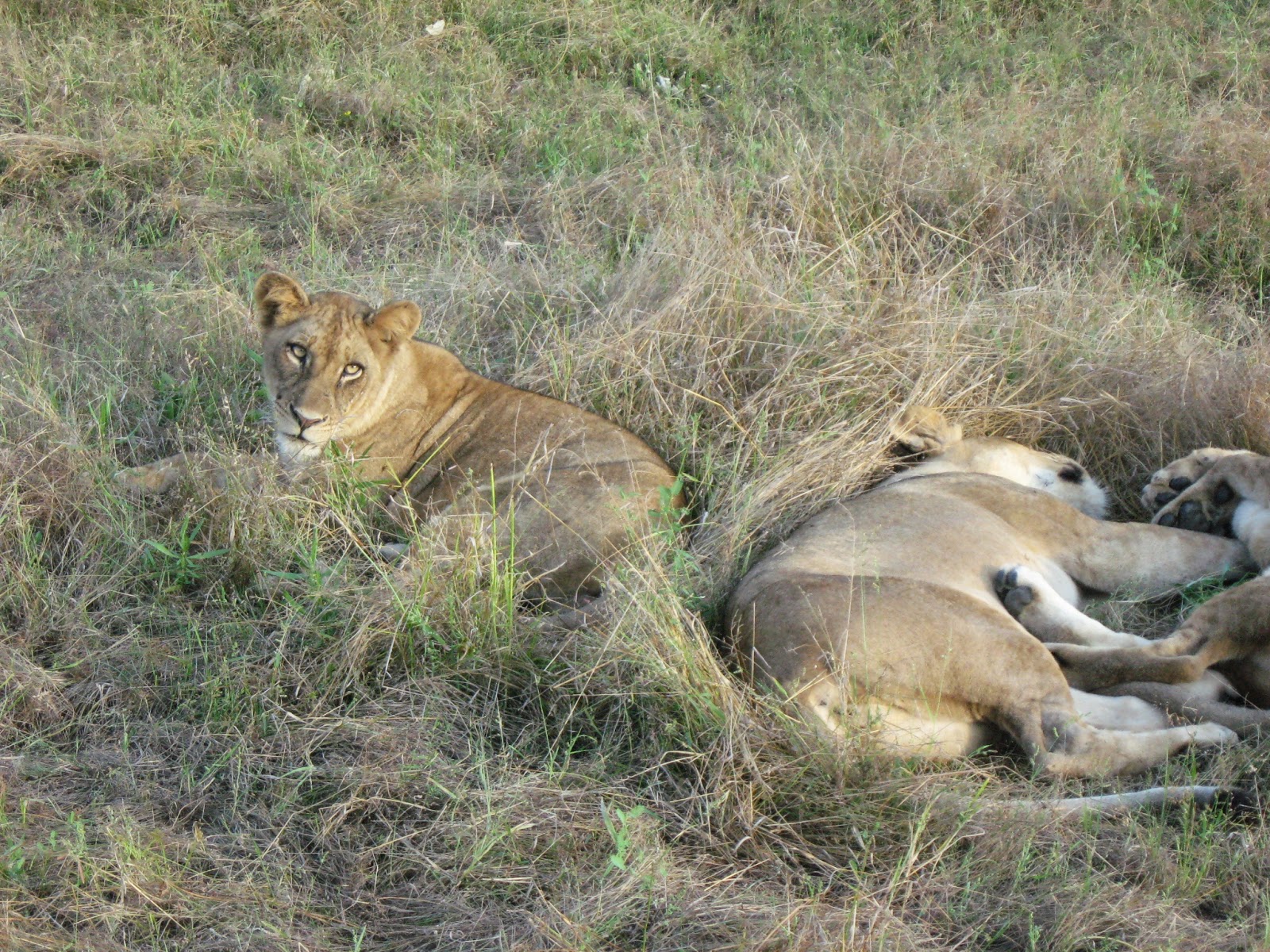
Yeah, it was looking right at me!

Enough excitement for one night, right? WRONG.

We found a beautiful spot on the Luangwa River. We enjoy our drinks and snacks as hippos (alive this time) were popping their heads up out of the water, twitching their ears. A large group of impalas and baboons were grazing in the nearby field. Mr. Heilman was the first of our group to be brave enough to go behind a bush and mark his territory so to speak when he saw a flash of spotted fur dart through the tall grasses toward some potential dinner. Soon the baboons were squawking and the soft thunder of impala hooves in motion caught our attention.

“Back in the truck!” Our guide spoke firmly. Becca was already in the vehicle. Finally ready to go, one of the guides showed a light into the field. The yellow eyes of leopard looked straight at us, maybe twenty feet away. I covered my mouth I was so enamored and surprised by its beauty and physical proximity. With all hunting prospects properly warned and fleeing, the leopard turned and stealthily walked into the nearby covering of trees. Its leg bones took turns rising up and down, tail slightly hovering off the ground, as it modeled its brown and black spots on the “catwalk.”

A leopard sleeping in a tree. SHH!


By then the Zambian night was upon us, darkness blanketing the park. We picked up speed while still shining our long-distance lamp this way and that around us looking for nocturnal animals. The road was bumpy and went to and fro. I suddenly felt as if I was inside some video game like “Frogger,” no longer an amphibian trying to dodge vehicles, but a vehicle trying to dodge the hundreds of impala, baboons, hippos and herd of elephants in the dark open plains. Taking a sharp turn, we accidently spooked a mother elephant. We were too close to her baby, I guess, and even in the darkness, I could see her charging.

“Faster, faster,” I thought. “Get us out of here.”

Against my instinct the driver slowed to a complete stop. “GO!” I thought. But our cessation of movement had communicated our acquiescence of her dominance: that we were not a threat. She stopped ten feet from our car, and we slowing inched forward and away.

And that was just our first game drive at South Luangwa National Park.
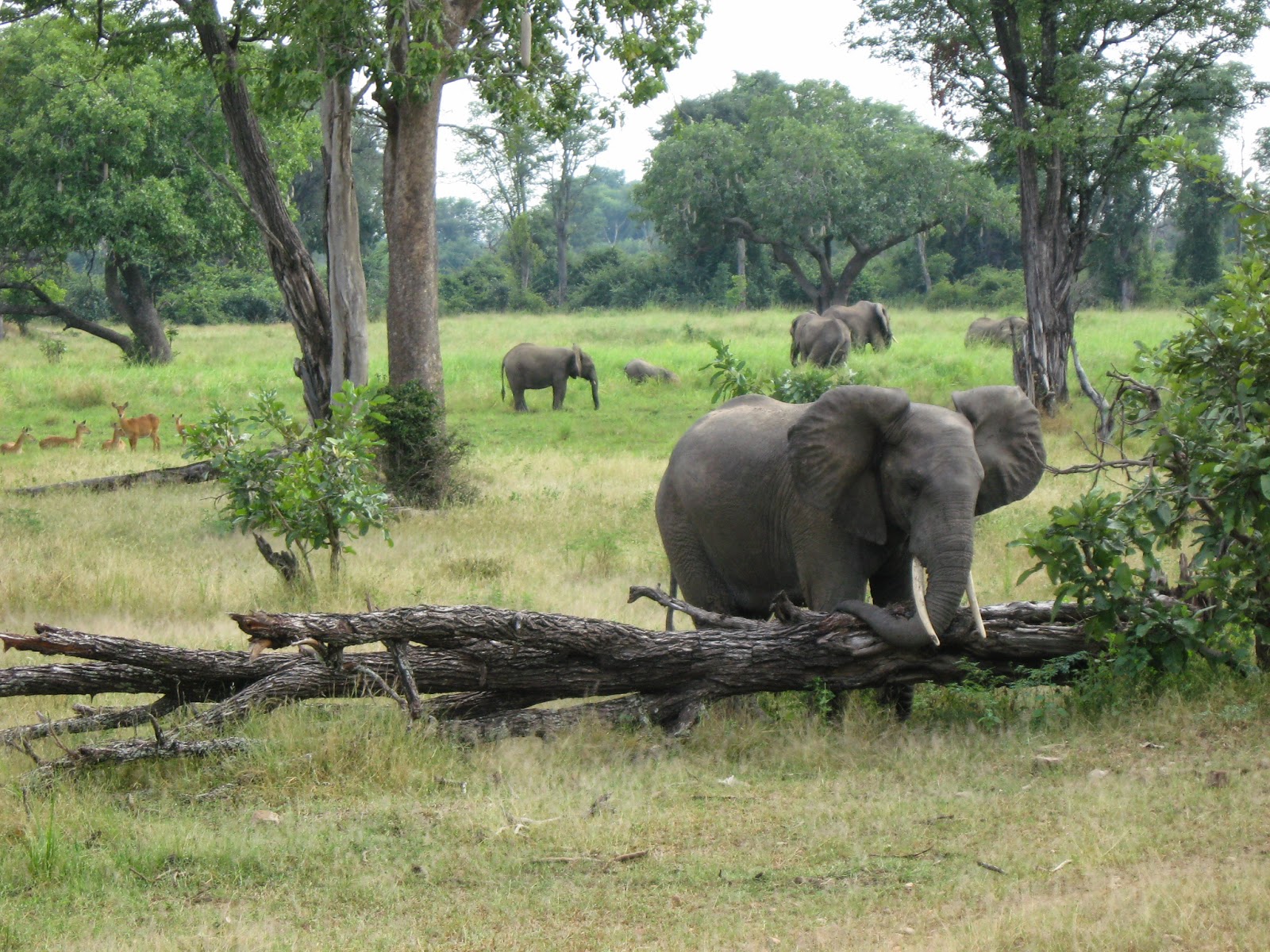
Elephants


Rebecca’s parents visiting from the United States graciously allowed me to accompany them on an adventure of a lifetime. South Luangwa is the best game park in the country and one of the best on the continent. South Luangwa is quite the contrast from my populated, urban community. It was a beautiful experience to see the open skies and clouds, colorful feathers of birdlife, various shades of greens and browns making up the flora of the area, and the mighty, mighty animals of Zambia.

I am amazed, truly, truly amazed by the beauty of this country.  As I hugged a Baobab tree that has been on this earth for 1500 years, I was humbled to be in the presence of a natural landscape that has been wild for hundreds of years.

Baobab trees: Making me feel short for 1500 years.


I pictured life in the nearby villages after observing a scene of children shouting and sending their dogs running up to scare a herd of elephants up ahead. What a life to live in the shadow of gigantic, life-threatening, and yet majestic animals? What a blessing and what a pest they must be in the villagers lives! And yet here I was paying to come see them.

South Luangwa lived up to the hype I heard about the game viewing . But no one told me I would be scared out of my mind. There was no safety video or talk before any of the drives. I was shocked by how close we got to the carnivorous cats in particular. We saw leopards sleeping in the tree during the day. At night, we saw four impala legs hanging from a high branch as a leopard devoured its body safe from hyenas and other scavengers who might want a bite. We saw two leopards walking down the road in the daytime. One got so close to our car, it was probably rubbing its fur on our wheels. I was too scared to move and look over the side of the truck. Nothing was stopping the animal from jumping up to greet me, or worse.

I took the opportunity to take a short walking safari through the mud. After mostly stopping to look at plants and animal scat, I found myself the last in our single file line and the only one to look to our left and see a very much awake leopard staring at us from a low branch less than thirty feet away from us. I was paralyzed but whispered to the elderly British woman ahead of me, “there’s a leopard in the tree…” Our guide and the man with the gun had missed the animal and were already twenty-five feet ahead of us blabbing about something I couldn’t hear.  I didn’t even get to enjoy the beautiful animal, because the tone of guide telling us to move quickly to him scared the living daylights of me. I stared at the ground, careful not to slip in the mud, but turned to watch the leopard slink down the tree. We heard the rustle of the bushes as it stalked off in the opposite direction.

Overall we saw at least three prides of lions. One lion even jumped and climbed a tree in our presence, a rare sight we were told. Each day I was amazed at how close the driver got us to these cats. Two strides and they could have been licking our vehicle. We were told as long as we stayed seated, the lions would see the vehicle as one entity, some strange animal they’ve gotten used to moving around about them. No danger, they said.

Other memorable sights were two racing giraffes, an elephant slipping down the riverbank into the water as if on a waterslide, a bushbuck barking in warning as a crocodile swam close to the edge of the pool, a giant bird swallowing a fish bigger than its sizeable beak, a lone wildebeest, a hippo munching on some Egyptian cabbage in the day time with some beautiful greenery stuck to its back, and hundreds of elephants or zebra each way you would turn. We saw a bush baby, African civets, genets, the white-tailed mongoose, the marsh mongoose, the elephant mouse, a kudu, and so so many beautiful birds. We also heard and saw lions while eating out delicious dinners two out of the five nights.

Hang on Baby Baboon!


Male impala
                                    
Finally, our last animal sight in the park was the most spectacular, violent and terrifying. Our guide received information that lions were in a particular area. We couldn’t find them in the evening light, but under the cover darkness we happened upon them. Two other vehicles were already on the scene. Between the three vehicles’ high-intensity lights we could see three lions on alert but lying low less than ten feet to the right of our car. Maybe forty feet ahead of us to our left there was one lion creeping forward toward a tree line.

It happened in such a flash. We must have only been there two minutes. An impala came running at us and right at a bush ahead of us, six young lions collided with it from all directions. You could hear the thud of animal body on animal body, of teeth sinking into flesh, the impala last words. In a flash and thunder of starting engines, the observing vehicles converged on the scene in a surrounding triangle. I heard Becca to my right, repeating the words, “Please stop, please stop.” She was talking to our driver, but I couldn’t help but say those words in my head to the lions. There wasn’t more than five feet between each vehicle and a mass of animals moving back and forth. I’m not sure if the movement was a result of the strength of the impala or the inexperience of the young lions, but pretty soon the impala’s head stopped moving and the mass of prey and predators sunk a bit lower to the ground.  It was then that a few of the lions took their teeth from their prey and moved their heads around gazing at all the spectators. A chill went down my spine. I realized that we basically had the animals cornered, the vehicles creating a barrier with some juicy human snacks in them. I felt Becca’s trembling on my legs and arms, and couldn’t believe I was seeing what I was seeing so close. And I couldn’t believe I was safe. I told the driver it was time to leave. I fully understand that lions need to eat, too, and I’m quite aware of the existence of a food chain. But now more fully aware of how gruesome that reality really is. It was interesting to have spent five days marveling at the beauty of life, and then finally be confronted with death. It was fascinating. It was horrifying. It was majestic.

When we returned to the lodge, I grilled our guide with questions about our safety in the situation, and he reassured me that the animals are quite used to the close proximity of cars and are much more interested in the fresh meat they have been hunting and eating for time immemorial. But something felt wrong about our intrusion and the barrier of the vehicles. We were there to learn about nature, but there was nothing natural about cars and laughing humans surrounding hunting animals. I think I could have enjoyed it more from a safer distance.

It was nonetheless an unforgettable experience. I might have lost some innocence, but today I am truly marveling at the both the peace and grace and simultaneous brutal violence of this animal kingdom we live in. I am in awe of the majestic place I am living this year.


The name of the lodge and safari business was Kafunta Safaris. Kafunta means crazy. Crazy Safaris. Yup, that’s about right.

HEY GUYS I'M ON A SAFARI!

At Kafunta River Lodge

A girl and her camera

A giraffe poking out to say, "Muli Bwanji?"

Becca, Myself, and Mrs. Heilman

Saturday, April 11, 2015

Grandma Weinberg

In the last three weeks I’ve watched two coffins lowered into the sandy, dark Zambian soil. One coffin held a grandfather and the other a grandmother. Men jostled each other to get a chance at the shovel to tuck the departed soul into eternal rest. Grandchildren waited their turn to put a flower into the grave.

Today I picture my own family gathered around a grave in northern Minnesota. Yesterday my family honored my mother’s mother with a church service of remembrance. Today they bury her ashes.  I can’t be there physically but I can picture the spot and the scene in my mind. Last summer, when my grandmother was in the hospital, I travelled to see and visit her, which I now realize was a beautiful goodbye. During the trip, my mother took me to see a cemetery with the graves of many family members. Looking for the names of my great-grandparents on tombstones, I was shocked to find myself staring at the name JEAN WEINBERG. It was a Scrooge-like moment. I found myself staring into the future, as if my grandmother had already died. My mother had forgotten to tell me that my grandmother had already installed her own tombstone. Minutes later it was a laughing matter and remains a good story, but today I am glad for the mental picture: my grandmother’s resting place. And I can see each of my uncles and aunts, cousins, father, brother, and mother encircling this place with their love and gratitude.

The following are the words I wrote in honor of my grandmother’s passing. My younger brother, Mitchell, did me the honor of reading them for me yesterday.

Grandparents are a mysterious blessing in our lives, and my grandmother, Jean Katherine Weinberg was just that. I knew her so intimately and yet there remains so much I don’t know. Grandma gave life to my mother and aunt and uncles, shaping the very adults who would shape my own life. Grandma will forever be in my memories of my early, formative years of life. She was around when I took my first breath. She was there for Christmases and birthdays and graduations. She was there when I was still figuring this world out, when I had big questions, when I had tears and laughter. She was there when I needed hugs and pushes out the door.

The relationship between grandchild and grandchildren is so mysterious because grandmother and granddaughter are living in opposite phases of their lives. Grandma met me when she was finally taking a load off in the lawn chair outside. I was running circles around her, singing at the top of my lungs. It’s such a beautiful paradox. The beginning meets the end.

I will cherish my memories of our beautiful meeting. I’ll remember my grandmother sitting on the couch, finishing up an entire book of word searches. I’ll remember one of her characteristic smiles-- one eye closed in a wink, scrunching up the left side of her face, her thumbs twiddling in her lap. I’ll remember feeling loved as I entered her apartment, seeing all my school pictures proudly displayed. I’ll remember her introducing me to the movie, Dave, because it was one of the only VHS’s she had. I’ll remember the excitement of her arrival at the train station in Milwaukee. I would have fun guessing which track her train would come, always hoping for the far one so she would get to use the underground ramp. I’ll remember her face lighting up when you told her she looked beautiful after getting her hair done. I’ll remember sleeping on the floor next to her in her apartment when my family would come visit her. I’ll remember being scared of her bathroom sink because I might see her dentures floating in a jar. I’ll remember her as strong and resilient, living independently and fighting so many health problems at the end of her life. I’ll remember her as someone who wanted to live, lying bravely in her hospital bed.  I’ll remember her quirks and some of the funny things she said.

I can’t quite put my finger on it, but I think there is something special in the generational line of females. From mother to daughter, to that daughter’s daughter. Within these relationships there is certainly times of challenge as the daughter rebels to assert her independence, but that never erases the fierce loyalty that connects grandmother to mother to daughter. I’m sad that this trio has been broken, but I remain fiercely loyal. My grandmother has left me a precious gift: my own mother. And now I have watched my mother take care, and love and forgive her own mother over and over again. Thank you grandmother, for mothering me and leaving me with a mother.

There are so many events from Grandma’s life that intrigue me: Born in Hollywood, valedictorian of her small class, survivor of a bus accident, spoiled and beloved girl-child, the first person in her family to graduate college, mother of four children born in four different states, famous and beloved in the Red Lake Falls community. I’ve looked in her scrapbook and seen her flirty captions, and I’m in awe by this woman that I knew and didn’t know. My grandmother is forever tied to my childhood, but hers will always remain a mystery to me. Now as an adult, I can think more broadly and wonder at her whole life—from girl to grandma. As I glimpse this whole woman, I am inspired. I am inspired by the mystery of the person I didn’t know, by her beauty then and even now. I’m inspired by her perseverance and love. I’m inspired that she lived and left a legacy of children, nieces and nephews, grandchildren and soon to be great grandchildren that she loved and loved her back. The web of people gathered around her in celebration now is a testament to this.

She leaves me now with intrigue at her life. So I will keep asking questions about her and musing about her, and thinking about how she has shaped my life. The beginning met the end in our relationship, but that circle continues.  She kept on throughout her entire life, and so too, will I. I miss you grandma, but you will forever be in my heart and imagination.


Friday, March 27, 2015

Unjust illiteracy

Almost everyday I walk into class and do one of the following. I might write a whole bunch of notes on the board. These notes could be about history, including names, places, things, and events far away that a Zambian has never heard about or seen. These notes could be about computers and technology, strange machines they’ve never used. These notes could be long and complicated English vocabulary words I found in our grade eight and nine textbooks.

If I don’t write notes, I hand out papers or books to read. This is a new development this term. We had a printer for a few weeks but then it broke. We now have 500 storybooks for the school to use. I occasionally photocopy some readings and multiple-choice questions at a local copy shop. The readings in the first chapter of the grade nine English textbook were about the history of radio, television, aircrafts, and modern kitchen appliances. They were all extremely Eurocentric. They were long readings, and they had lots of big words.

If I don’t hand out reading material, I might just start talking. I don’t talk like a Zambian. I have an accent. I use American English instead of British English. While I try everyday to talk slowly and use a mix of easy vocabulary that they will understand and advanced vocabulary so they can learn new words, I nonetheless use a complicated vocabulary my students are not used to. When I asked students to write about one difficult thing they encountered this semester. One student honestly wrote, “I could not understand Teacher Hannah. When she askes us if we understand, I just said yes.” True. Honest. A reality. I’m glad he wrote it. And it stings my heart.

I ask my students to read every day. Read these notes I wrote. Read this book I am giving you. Read this poem on the board. Read these homework questions. Read these directions for an exercise.

Everyday I ask my students to write. Write the answers to these questions. Write about this history topic. Write about the computer topic. Write about your life.

Every single day.

And every single day my students must feel so helpless. They must feel so frustrated. They must feel so exhausted. They must feel so bored.

Why would they feel this way?

Because they can’t read and write.

These students are in grade eight and nine, some are as old as seventeen years, and they can’t read and write.

Sometimes this is unfathomable to me. I barely remember a time I couldn’t read or write. I don’t know what its like to not have the means to express myself and understand the communication from others.

I’ve taught for two school terms in Zambia and in both terms it took me weeks to find out who was illiterate. Weeks. That is unacceptable.  I am failing these kids in so many ways.

Can you imagine what it feels like to be asked to read and write everyday and not know how to do it? I just imagine some of these students thinking, “Yeah, you want us to answer these questions. TEACH US TO READ. You want me to write a good essay question? TEACH ME TO WRITE!”

And I’m trying. I’m trying so hard to teach these kids to read and write. But there are so many of them and only one of me.

I am daunted by this grade nine test all of my students will have to take, either this year or next year. Some have already failed and are in grade eight or nine for the second time. This test will expect them to read and write at a grade eight and nine level. I’ve seen practice tests and they would give any American high schooler a challenge. And yet illiterate students take these tests in Zambia every year. And then they fail. And take many years to complete their education. Or they fail and drop out and continue living a life in poverty.

This world is so unjust. These kids want to read and write so badly. They want to succeed. They want to grasp opportunity. They show up to school everyday. Their eyes are on the board, a pen in their hands. Their hands are open to the world, ready to give themselves and work hard. But those hands remain empty. I give them notes and a few books, but it’s not enough. They don’t have books at home that could have helped them to learn to read at an earlier age. They don’t have books at home to teach them now.

What is it like to stare at a page of letters, knowing they mean something… knowing these words unlock the key to success, to a future, to understanding, to so many things? What is like to stare at those words…and unlock nothing, to understand nothing?

It’s messed up. This is messed up.


I’m failing. And if you are reading this I don’t need a whole bunch of emails, saying, oh Hannah, you are doing your best. You’ve given them so much in other ways…blah, blah, blah. I’m sure I would actually appreciate that very much, but instead I invite you to look at this situation and see that yes, I am failing. The challenges to teaching Zambian kids to read in urban poverty are staggering. I want you to see that and feel that with me. I want you see that this is unfair. And I want you see that it’s not just me failing. It’s society. It’s our world. We are failing so many kids everyday. People in this world are not getting their needs met, be it food or education. Why do we the kids with the most resources keep getting more? And the kids who need the most keep getting less?

Wednesday, March 18, 2015

Mr. Mugala

Devin, me, Rebecca, and Mr. Mugala 

Mr. Mugala was a great man. In the words of Reverend Phiri, he preached his own funeral sermon by his very life. Today I read scripture at his funeral and put a flower in his grave. I got to hug his grandson. I shed tears with his wailing wife, daughters, sisters, and grandchildren.

Mr. Mugala was the first Zambian to welcome me into his home. He and his wife and grandchildren welcomed the three YAVs into their rural, village home during our first week in the country. At 78 years old, he walked us up and down the beautiful rolling hills. He told us stories and myths from his village. He explained cultural practices we didn’t understand. He was good man. It only took me four days to see that.


I will forever remember his kindness and his warm, warm smile. Rest in peace.

Sunday, March 15, 2015

Taking Home Trophies!

This past Thursday I got to relive my glory days. I was back at the starting line for a race. I was back on the court. In celebration of Zambia’s holiday called Youth Day, CCAP youth from Midlands Presbytery gathered at field on the campus of University of Zambia. I got to dust off the old running shoes (and by dust of I mean wipe off the mud of rainy season that cakes them) and run and shoot some hoops again.

I got to the football (soccer) pitch when the first heat of boys took off in a 400 meter dash. Immediately my heart was in my stomach and my adrenaline was pumping. I knew this feeling of squeamish excitement. The same butterflies used to visit me before a race or game began. Pretty soon it was time for me to race. I took off at a good pace and trailed slightly behind one girl in front of me. I lost some ground around the perpendicular turns (this was not real track but a rectangular field) and around the 200 meter mark the “tireds” set in. Not knowing if I could keep up the pace, I just kept on keeping on. The final turn was coming up. The last stretch. This was my sweet spot. Always has been. Hopefully always will. With a little over 100 meters to go, I turned on the gas and passed up my competition at about 50 meters to go!!!

I vividly remember my sister, Precious’s, distinct cheering as I made my final push.

Yes, I love racing. That hasn’t changed.

Next was netball. Not to be confused with basketball. I learned that lesson pretty quickly, although I also learned I couldn’t quit some of my basketball habits. Netball is a very popular game for women in Zambia. It is played on asphalt with two hoops and various lines on the ground that determine if a player is off sides. Only the one center player on each team has full range of the court and one other player, the shooter, always stays near the hoop.


Similar to basketball, the ball is thrown up in the air at the center of the court. But unlike basketball, once a player has the ball they must almost immediately pass the ball. At one point I thought I was showing off some awesome pivot moves, giving my teammates some time to get open, when I found out I had violated the rules and needed to pass the ball immediately after I had secured it. I quickly learned that my passing habits from basketball also needed to change. In basketball, low, fast passes are great to get the ball to an open teammate. In netball, one barely has enough time to find an open player so high, lofty passes are better to give your teammate time to jump or position themselves to get the ball.   These rules make for fast paced, scrappy game, and oh my, these ladies got into it. We played two halfs, each to seven points, and in the end Lusaka Central (my congregation—woot woot!) took the trophy home!

This was one of the most fun days I’ve had in Zambia. There is something special about playing sports. Other worries dissolve as you focus on the game. A hard race takes your breath away, but when your breath comes back the endorphins and pumping heart give you a feeling of healthy accomplishment. Playing netball was an awesome way to cross cultures. They were teaching me something new, and even graciously forgiving my mistakes. Whereas I often find myself hitting a language barrier, lost in Nyanja, Tombuka, or Bemba conversations I don’t understand, as sports players we communicated with simple language, body positions, smiles and high fives. When I scored my first point, I was so surprised I did this raised double fist thing in celebration, and let me tell you, everyone got a kick out of that.


I am very thankful for this opportunity to do something I love with the people I love here.


Thursday, March 5, 2015

Muddy Toes

A few hours ago the mud was oozing between their toes. They held hands and giggled as they moved their feet ever so slightly so as to push the dark, gooey earth into the tiny spaces between the big toe and that next toe. The rains had finally stopped, for today at least, and the Zambian sun was poking through the clouds, attempting to evaporate the temporary lakes that sprout up around the compounds of Lusaka that time of year.

They both wore tattered clothes, perfect for playing. The kind that just invite you to jump in puddles, roll around in the dirt, and play catch with whatever garbage you can find. She had been wearing the garments since Tuesday, but his were fresh despite their appearance. He had just changed out of his school uniform.

While he learned his ABCs with Catholic sisters, she learned how to wash the mountains of clothes that gave their family work, but not a living wage. While he was mastering the Zambian National Anthem,  she was mastering the latest pop song from the slurred words of a neighbor drinking a fermented corn drink at the local one room pub. While he learned the days of the week, she learned that more people in the market on Mondays and Fridays meant more people to ask for money. While one had a round belly from plenty of nshima and relish, the other had a round belly from malnutrition. While he walked home with notebooks in his backpack, she walked home with her baby sister on her back, exhausted from being left to care for her all day.

But in that beautiful, muddy moment they stood the same, equal distances from each other’s front door. The open area between their homes was their playground, their meeting place…common ground.

Game on!

They splashed in puddles. They pulled their toy cars made out of paper alcoholic beverage containers. They jumped into the garbage pit behind the nearby school, painted blue, to scavenge for playthings. They chased each other through the big boys playing football. They told each other secrets as the woman in a brightly colored chitenge passed, muscles flexed, holding water on her head. They belted out songs about Jesus as they lay in the dirt, drawing pictures with sticks. They chased the chickens around his house and then they chased the chickens around her house. They joined a circle game with other children, holding hands, running, and chanting at the top of their lungs. They stood back to back to see who was taller, each stretching onto their tippy-toes, chins to the sky.

But it was no use.

They were the same.

Until the call…always from his big sister. She shouted his name, telling him to return home. He waved to her and turned to run.

It had gotten dark, but there was enough light to watch him bound the fifty yards into his sister’s waiting arms. A big wind whipped the unraveling hem of her dress and she felt a chill as she heard his wooden door slam. A soft thundering in the distance couldn’t cover up the rumbling in her stomach. Kicking stones as she walked, she returned home.

Nothing waited for her there. Her parents hadn’t paid the electric bills in months so she rummaged around to find a match and candle. With this slight illumination, she could see the charcoal brazier cold and unused. The table was empty, the cupboards bare as can be. Standing in her front doorway, she looked down the street filled with tiny snack shops and makeshift hair salons, looking for the familiar image of a woman walking with her wash. There was no sign of her mother.

Needing something to pass the time she wandered back to her playground, this time alone. A mangy-looking dog, who obviously had already had her share of pups, growled from the corner by the bore hole and water spicket. Wanting to get out its way, she kept walking until she found herself in front of a wooden door. His door.

She tip-toed toward it until her nose rested right in that miniscule channel between door and doorframe. Odors of Nshima, the Zambian staple food, and salty, oily, green relish wafted her way. And what else? She sniffed. Chicken. Definitely a nice plump village chicken, usually only saved for special occasions and holidays.

She heard an “amen”, and then the rush of water into a metal bowl, washing the hands of his family. Then there was the scraping of plates, picked up and passed around the table. She heard the clank of metal lids uncovering the delicacies within the tin dishes. She closed her eyes and started stroking the fingers of her right hand onto her palm, the familiar motion used to roll nshima in one’s hand before taking a bite. Hearty laughter from within woke her from her dream, causing her to jump and hit her head on the doorknob.

With one hand rubbing the newly sore spot on her skull, she cleared her throat and yelled in her high-pitched voice, “Odi!” This was the greeting yelled at Zambian entrances, asking for permission to enter. Again, she cried, louder this time, “ODI!”

The chatter from within hushed before his mother answered her, “Yeo!”

Slowly the door creaked and she stepped into the hallway lit up from the excess light of the nearby dining room. Pulling the green, fake silk curtain hung in the doorway, she immediately fell on her kneels before the wooden table. Six well-fed people stared back. Her eyes barely reached over the big piece of furniture, but her eyes still met his.

This, too, was a meeting place, but instead of hand in hand, she was knee to ground and he was raised above her on the comfy chair at the head of the table. Her mouth asked his mother for two kwatha, the equivalent of 30 cents, but her eyes stayed locked on his. They stared into each other eyes, remembering the warmth of the other’s hand and the cool of the mud on their toes. They used same eyes as before, but this time their places had changed. She waited expectantly.


Explanatory Note: This is a work of fiction inspired by my life here in Zambia.
Every few months or so a neighbor girl, whose mother helps wash our family’s clothes, knocks on our door at dinnertime. She kneels down in front of our table heaped with food and asks for money. When it happened this week, it struck me that this girl had just been playing with my host-brother a few hours ago. A short time ago they were just children, equal children, having fun outside. Then at dinnertime there was shift. He went to a table filled with food. She went to beg. I wonder how this makes each of them feel. How does it feel to come beg at your friend’s dinner table? How does it feel to be swallowing food but seeing your friend at her knees? Poverty is all around Zambia and the compounds, but I’m also struck by the interconnection of people at various levels of financial security. Those children coming from families that are doing pretty well—relatively no food insecurity, have bigger houses, even nice televisions—play in the same spaces and wear the same type of play clothes as the children coming from families who are living dangerously on the edge of survival. I imagine this type of close relationship to have its pain in apparent and felt inequality between friends (ie. episodes of begging at a dinner table). And yet, I wonder what transformation can come from these relationships. I wonder if affluent people might share more if they had children knocking on their door at dinnertime. Would it inspire sharing, community organizing and social change if our childhood friends weren’t just from our own economic sector of society, but included people from all sorts of backgrounds?


Wednesday, February 25, 2015

We should be more grateful...FOR MY STUDENTS!

Today I was standing outside waiting for school to start, sort of feeling bad for myself because I am fighting a small cold with violent sneezes, and this miracle bumps into me. This bright, beautiful, smiling face, located a few feet below mine, strikes up a conversation with me. I wish you could have heard her bubbly voice, her optimism, her giggle.
            “I told my mom,” she began, “I want to go to school. I really want to go to school. Why am I not in school, mom? My mother said, ‘What school do you want to go to, child?’ ‘I want to go to…to…(‘What’s the name of our school?’ she asked me. ‘King David,’ I reminded her.) Yesssss! King David! I want to go to King David School! And I am so happy since I came here. I love learning so much! I love learning everyday. My mother told me, ‘Child, then we will not have money for food.’ ‘As long as I am learning, that’s enough,’ I said.”
            “So you don’t eat lunch?” I asked the student.
            “Haha. No,” she smiled, though it seemed an odd response to me. “I haven’t even had a 50 ngwee coin these past two days. But I’ve been at school.”
            Wow. So all the times I go into my house and eat lunch, this child has gone hungry. And she feels school is more important than eating. School is more important than nourishment. She loves school more than food.
            Now I love school. I’ve always loved school. I love learning and being a student. I love school. But I’ve never, never ever had to choose between school and lunch. I’ve never had to beg my mother to send me to school.  
            A few weeks ago, I assigned a writing prompt to my grade 8 class. The task? Write a summary of your life. We have been working on choosing important points from a reading and writing them down in our own words. I was so humbled by my students’ stories. The common themes were parents dying and no money for school fees. One student stands out. After both his parents passed away, he stopped attending school for three years. Three years! No school! When he started attending King David School, he found that he actually loved the learning environment. He passed his grade 7 exams and now often has the best performance in my grade 8 class. He’s one of my best students and he missed three years of school. He wrote in his summary that he often advises his friends to go to school to that they can take responsibility for their own lives. Can you say, this kid should be president?
            Often times I get caught up in the obstacles of simply offering instruction here. I think, we need more books, better desks…I’m sick of writing on the chalkboard…I want to teach more creatively. These are real and certain injustices and must be corrected someday, but I often forget what King David School already has going on. It is a functioning school. Teachers show up. Students learn something. Many pass their exams, or return for a second try. It’s a school, and so many students are grateful and learning. It’s a miracle.
            I think about my own education as a child in the United States, I can’t believe all the times I grumbled about going to school. I want to say people in the United States need to be more grateful for what they have, but I know that’s been said a million times, and still so many Westerns aren’t truly grateful and we still haven’t made an equal world. Instead, of thinking, I should be more grateful for what I had, I think I need to keep the focus on my students and not myself.  What should I learn from their stories? My students are inspiration, that’s what. They are strong. They are smart. And they deserve better. Many inner city schools in the United States deserve better, too. Instead of focusing on being grateful personally, let me be grateful that the world is full of students who love learning even when there are so many obstacles to their education. Let’s be grateful that this world has an untapped resource in its optimistic children. Let’s be grateful and let’s do something to tap that resource. Let’s invest in a more equal world. Be grateful for my students.

Job update:

I realized I haven’t updated my blog with my job changes this term. This term I am focusing solely on grades 8 and 9. Each class had fewer than ten students on the first day of school, but now grade 8 has 20 students and grade 9 has almost twenty five! I am teaching English, Zambian/African History and Information Communication Technology (ICT).  My class schedule changes every day, but with six classes, I teach most periods of the day and always find schoolwork to do in my few hours of free time. This term I have new textbooks for ICT, History, and Grade 9 English. These extra resources have been a lifesaver, although I often come up with my own tasks, writing prompts, etc. This is the first year King David has offered ICT, spurred by the fact that grade 9 students will be tested on the subject starting this year. I try to include as much practical computer work as possible, but that is difficult with only my laptop for a computer. Today marks exactly half of our 13-week term being complete. We’ll have another break after the first week of April.